
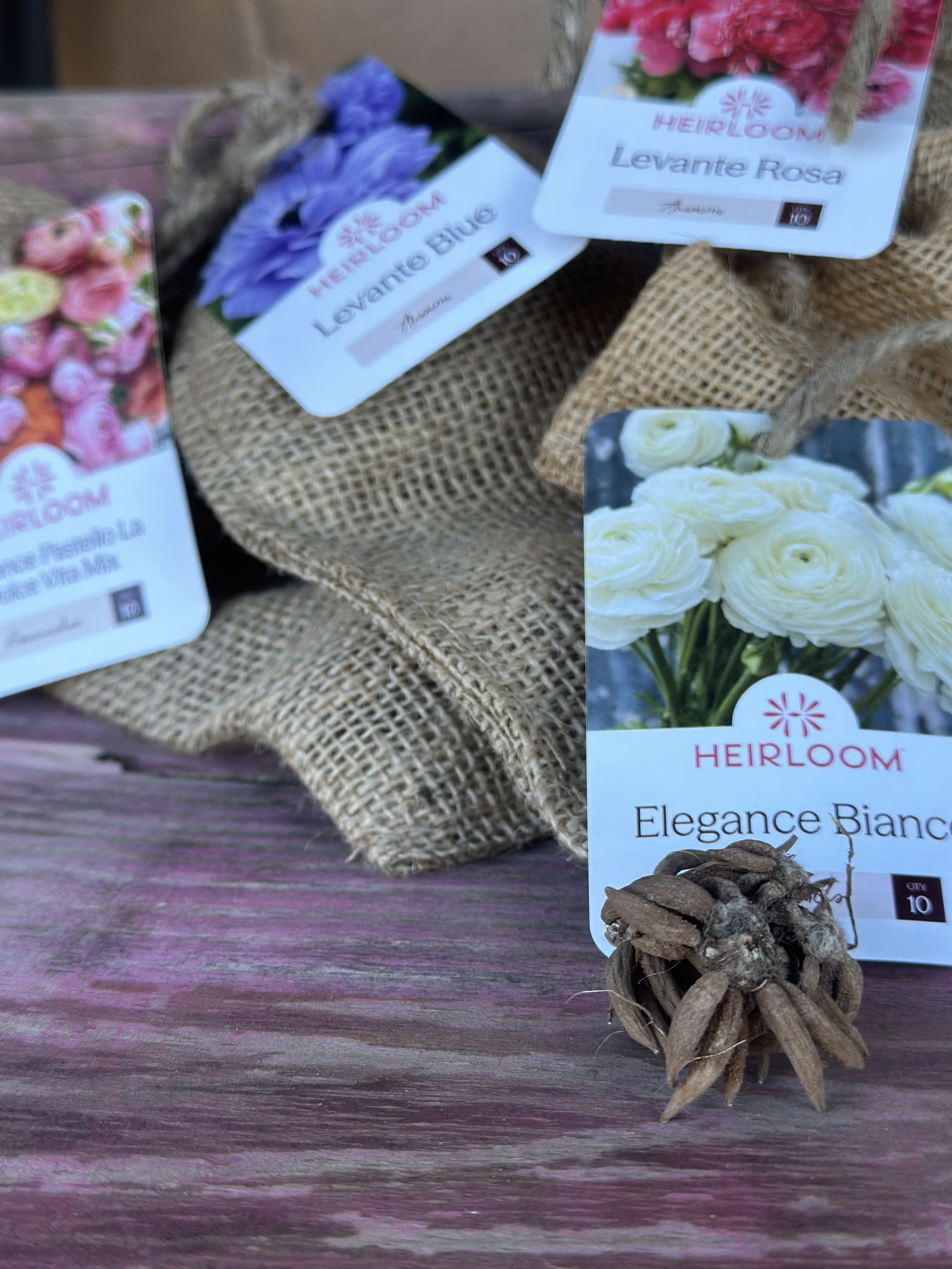
There are flowers you grow because they’re practical, flowers you grow because they’re beautiful, and then there are flowers that make you wonder how nature managed to create something so extravagant.
Ranunculus falls squarely into that last category.
With layers of delicate, paper-thin petals, these blooms resemble something between a garden rose and a peony. Romantic, a little dramatic, and surprisingly complex for something that begins life looking like a dried-up octopus.
A Little Botanical History
Ranunculus belongs to the buttercup family, Ranunculaceae. The varieties favored by modern florists are primarily cultivated forms of Ranunculus asiaticus, or Persian buttercup, native to the eastern Mediterranean and parts of western Asia.
Cultivated in European gardens for centuries, ranunculus became particularly fashionable during the 17th and 18th centuries, eventually developing into the spectacular, densely petaled varieties we know today.
Its name comes from the Latin for “little frog,” a reference to the damp habitats favored by many wild buttercups.
A rather humble name for such an extravagant flower.
A Persian Prince & a Broken Heart
One romantic legend tells of a young Persian prince who fell hopelessly in love with a beautiful nymph. Too shy to confess his feelings, he sang to her instead. When his love went unreturned, he died of a broken heart and was transformed into a ranunculus, its countless petals forever concealing his unspoken affection.
While the story’s ancient origins aren’t firmly documented, it’s a lovely piece of flower folklore.
In the Victorian language of flowers, ranunculus carried the message:
“You are radiant with charms.”
Rather than declaring passionate love, these flowers expressed admiration and the quiet wonder of being completely captivated by someone.
From Curious Little Claws to Beautiful Blooms
One of my favorite things about ranunculus is how unlikely its beginnings are.
What growers commonly call corms are actually tuberous storage roots. They’re small, brown, claw-shaped structures that look more like something excavated than something destined to flower.
These little structures store the energy needed to survive dormancy and begin growing again when conditions are favorable.
Ranunculus thrives in cool weather, making fall planting an appealing choice here in Rio Rico. With well-drained soil, consistent moisture, plenty of sunlight, and protection from hard freezes, we’re hoping for a beautiful spring harvest.
Of course, gardening in the Arizona high desert always involves a little experimentation.
The Florist’s Darling
Ranunculus has become a favorite in modern floristry, and it’s easy to understand why.
Their extraordinary petal structure brings softness and texture to arrangements, while their colors range from creamy whites and delicate blush to apricot, copper, crimson, and deep burgundy.
They’re particularly beautiful alongside garden roses, anemones, sweet peas, and seasonal greenery.
Harvested at the proper stage and cared for well, ranunculus can offer approximately 7–12 days of vase life, making them as practical for floral design as they are beautiful.
Despite their romantic reputation, ranunculus also has a less charming side. Like other buttercups, the plant contains irritating compounds and is not edible. Historical medicinal associations shouldn’t be mistaken for proven modern medical uses.
Growing at The Metal Petal
For our first season, we’re experimenting with several beautiful varieties, including Elegance Bianco Sfumato, Pastello Striato, Hot Pink Striato, and the wonderfully moody Tecolote Café.
Each was selected for its distinctive color, petal structure, and potential in romantic, garden-inspired arrangements.
The goal isn’t simply to grow beautiful flowers. It’s to discover which varieties thrive in our high-desert conditions and which produce exceptional stems worth sharing with our community.
There’s something wonderfully optimistic about planting a dried little claw in the autumn soil and trusting that, come spring, it will become something extraordinary.
Perhaps that’s why ranunculus has inspired so much romantic symbolism.
Here at The Metal Petal, we appreciate flowers with a little history, a little mystery, and plenty of personality.
Grown in the Arizona high desert. Gathered with intention. Shared with love.
Sources & Further Reading
Historical note: The Persian prince story is shared as popular flower folklore rather than a verified ancient myth.
#TheMetalPetal #Ranunculus #FlowerFolklore #LanguageOfFlowers #ArizonaFlowerFarm #GardenGrownFlowers
